
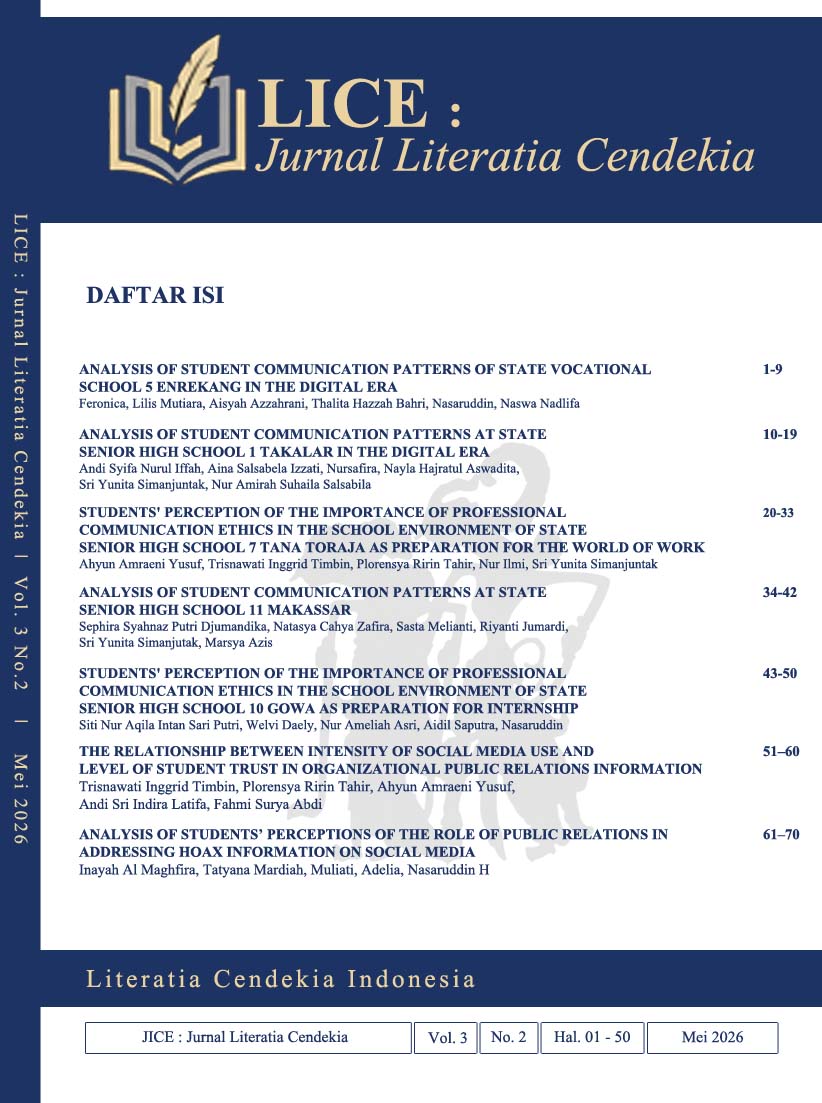
The ANALYSIS OF STUDENT COMMUNICATION PATTERNS AT STATE SENIOR HIGH SCHOOL 1 TAKALAR IN THE DIGITAL ERA
Keywords:
Communication patterns, SMA Negeri 1 Takalar, Digital LiteracyAbstract
The dynamics of communication in education in the digital era have changed the way teachers and students interact, creating new challenges in teaching character values and academic materials. This study aims to analyze in-depth the digital communication patterns of students at SMA Negeri 1 Takalar and identify the psychological and technical barriers that arise in the contemporary learning ecosystem. Using a descriptive qualitative approach and a non-experimental survey method (distance research), data were obtained from 78 respondents through a digital questionnaire using Google Forms. The study results indicate ambivalence in communication; although 48.7% of students rely heavily on social media (Instagram/TikTok) as their primary source of information, 39.7% of respondents still prioritize face-to-face interaction for academic consultations to avoid misunderstandings. Other findings indicate that 46.1% of students feel that informal language is more effective in building social closeness, but on the other hand, there is a psychological barrier in the form of digital anxiety in 34.6% of students when having to initiate formal communication. This study shows that students' communicative self-efficacy is better in field practice situations (38.5%) than in classroom theory. Therefore, strengthening digital literacy, which includes communication ethics (netiquette) and the ability to adapt to language codes (code-switching), is necessary to align academic formalities with the flexibility of digital interactions in the era of Society 5.0.
References
Azizah. (2022). Karakteristik Gen Z dalam Penyerapan Informasi Visual.
Azizah. (2024). Pengaruh Pengakuan Langsung Guru terhadap Kejelasan Informasi Akademik. International Journal of Digital Learning.
Fauzi. (2024). Dampak Ketergantungan Pesan Instan terhadap Tekanan Psikologis Siswa.
Gunawan, & Saputra. (2024). Adaptasi Platform Visual dalam Komunikasi Lembaga Pendidikan.
Lestari. (2024). Kecerdasan Interpersonal Siswa dalam Lingkungan Praktik Lapangan.
Nugraha. (2022). Pengalaman Belajar Langsung dalam Lingkungan Praktik.
Pratama, & Sari. (2022). Analisis Isyarat Non-Verbal dalam Komunikasi Berbasis Teks.
Rahmawati. (2023). Fleksibilitas dan Objektivitas Pengumpulan Data Jarak Jauh.
Rahmawati, et al. (2025). Pentingnya Komunikasi Asinkron dalam Tim Digital.
Rahmawati, et al. (2026). Pendidikan Etika Komunikasi Daring untuk Mengurangi Hambatan Psikologis.
Ramadhan, & Fitri. (2022). Bahasa Non-Formal sebagai Alat Pengikat Sosial Remaja.
Santoso, et al. (2025). Tantangan Adaptasi Kode Bahasa dalam Komunikasi Profesional.
Wibowo. (2022). Akses Internet dan Ciri Khas Generasi Z.
Wulandari, & Pratama. (2022). Konteks Situasional dalam Koordinasi Daring. Jurnal Literasi Digital.
Yusuf. (2024). Reduksi Bias dan Kejujuran Responden dalam Kuesioner Daring.
Downloads
Published
Issue
Section
License
Copyright (c) 2026 Literatia Cendekia

This work is licensed under a Creative Commons Attribution 4.0 International License.