
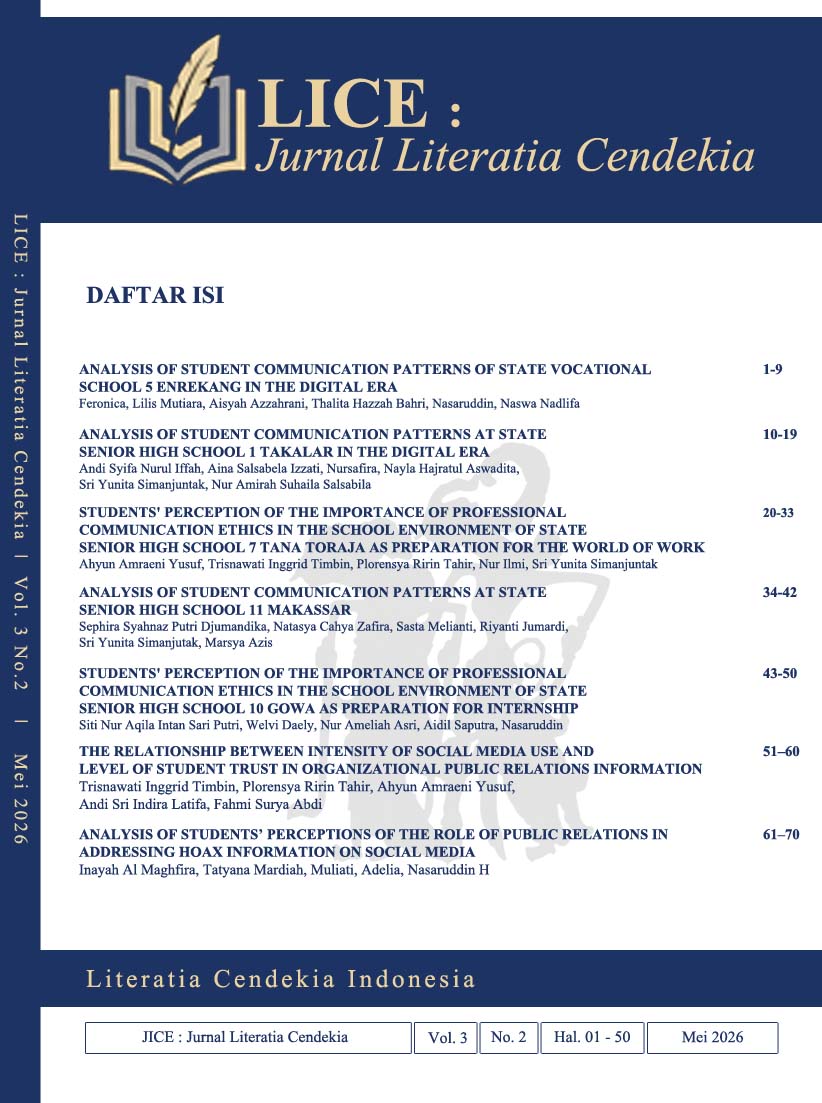
The ANALYSIS OF STUDENT COMMUNICATION PATTERNS AT STATE SENIOR HIGH SCHOOL 11 MAKASSAR
Keywords:
Communication Patterns, High School, DigitalAbstract
This study is motivated by changes in students’ communication patterns due to the development of digital technology, which affects the quality of interaction in the school environment. The study aims to analyze students’ communication patterns, identify influencing factors, and examine communication barriers. The research employs a descriptive qualitative approach with an online survey design. Data were collected through a digital questionnaire distributed via Google Forms to 36 students who are members of a WhatsApp group, using a non-probability sampling technique. Data analysis was conducted through data reduction, data display, and conclusion drawing, supported by simple percentage calculations. The results indicate that face-to-face communication is still considered more effective in formal situations, while digital communication is more dominant in informal interactions and information sharing. Factors influencing communication patterns include the use of informal language, self-confidence levels, and the development of social media. The identified barriers include the risk of miscommunication in digital interactions and psychological barriers such as hesitation in communicating with teachers. In conclusion, a balance between digital and interpersonal communication is necessary, along with improved communication literacy and students’ self-confidence to achieve effective communication in schools.
References
DeVito, J. A. (2016). The interpersonal communication book. Pearson Education.
El Hidayah, R. (2023). Pola komunikasi efektif dalam pembelajaran. Jurnal Pendidikan Komunikasi, 5(1), 78–92.
Hidayat, D. (2020). Etika komunikasi dalam media digital. Jurnal Komunikasi, 12(1), 45–56.
Kemendikbud. (2023). Panduan digitalisasi pembelajaran di sekolah. Jakarta: Kemendikbud.
Lasswell, H. D. (1948). The structure and function of communication in society. New York: Harper & Brothers.
Mulyana, D. (2017). Ilmu komunikasi: Suatu pengantar. Bandung: Remaja Rosdakarya.
Nasrullah, R. (2015). Media sosial: Perspektif komunikasi. Bandung: Simbiosa Rekatama Media.
Sari, D. P. (2022). Hubungan kepercayaan diri dengan komunikasi interpersonal siswa. Jurnal Pendidikan, 4(2), 45–56.
Sugiyono. (2019). Metode penelitian kuantitatif, kualitatif, dan R&D. Bandung: Alfabeta.
Widyaningrum, A., Pratiwi, R., & Santoso, B. (2024). Pengaruh gadget terhadap interaksi sosial siswa. Jurnal Psikologi Pendidikan, 8(1), 112–125.
Watie, E. D. S. (2016). Komunikasi dan media sosial. Jurnal The Messenger, 3(1), 69–74.
Yusuf, S. (2017). Psikologi perkembangan anak dan remaja. Bandung: Remaja Rosdakarya.
Puspita, R. (2026). Pola Komunikasi Siswa dalam Pembelajaran Daring.
Rahmawati, D. (2024). Komunikasi Digital dalam Pendidikan.
Sari, N. (2023). Pengaruh Media Digital terhadap Kepercayaan Diri Siswa.
Kurniawan, A. (2022). Efektivitas Komunikasi dalam Organisasi Pendidikan
Pratama, R. (2021). Etika Komunikasi di Era Digital.
Putri, L. (2025). Preferensi Media Komunikasi Mahasiswa.
Downloads
Published
Issue
Section
License
Copyright (c) 2026 Literatia Cendekia

This work is licensed under a Creative Commons Attribution 4.0 International License.